Pulsa la lupa para activar el zoom. Mueve el ratón sobre la imagen.
Home Studio
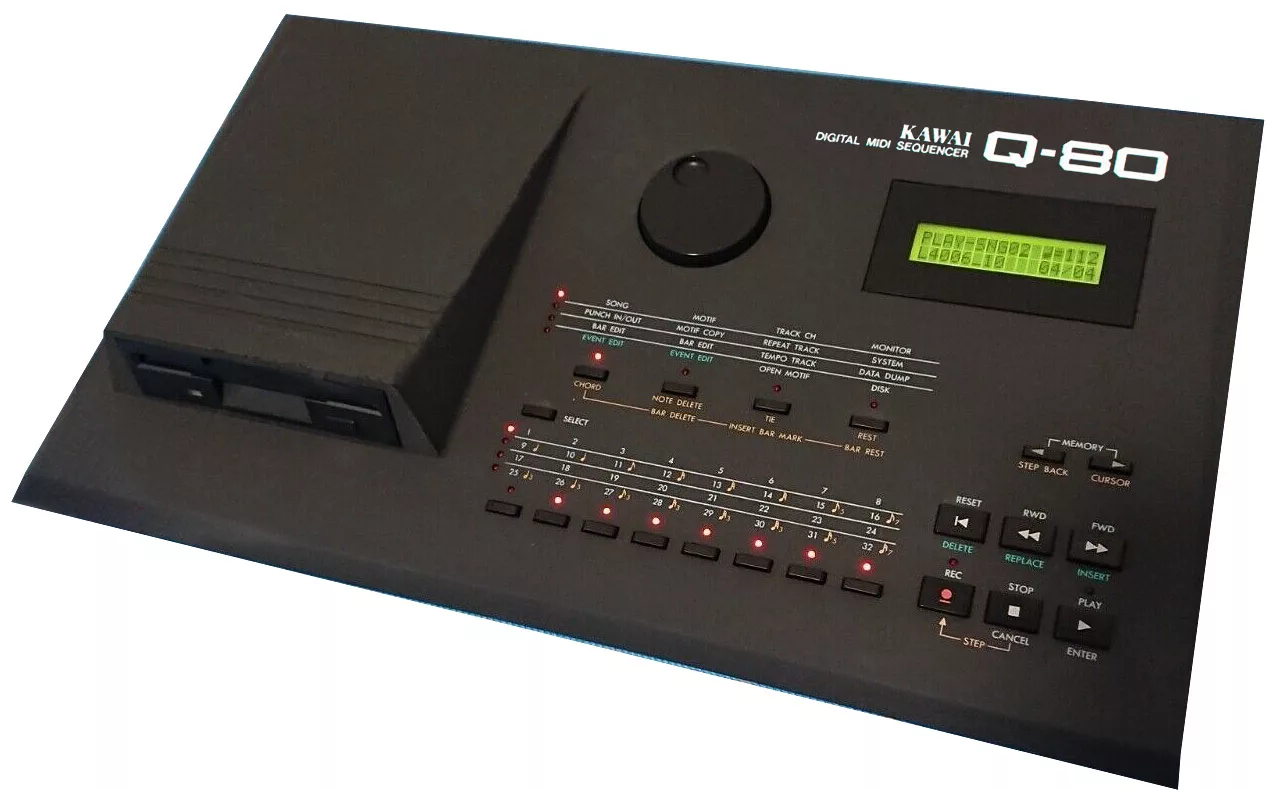
Kawai - Q80
150,00 €
28922, Alcorcón · Publicado: 2026-02-11 16:47:36
Model: Q80
Release Date: 1989-01-12
Creation Date: 2024-12-07 17:22:58
Description
The Q80 is a MIDI sequencing module with 32-track capacity. Features include a 26,000-note capacity, real-time and step-time recording and editing, 10 songs with up to 32 tracks each, SysEx storage functions, a special mode called TMotifU (a recurring musical motif stored separately from the 32 tracks; up to 100 motifs can be stored as part of a song), and a built-in 3.5" disk drive.
An enhanced version of the original Q80 sequencer, the Q80ex offers 32 tracks / 1000 motifs / 10 songs of memory, 52,000-note capacity, full editing capabilities, 2 independent MIDI outputs for 32 MIDI channels, real-time and step recording, compatibility with Standard MIDI File formats (both Type 0 and Type 1), and expanded system-exclusive recording functions.
This compact hardware sequencer does not offer the same workflow or possibilities as software sequencers. Some may argue that it lacks advanced features—for example, it is impossible to graphically edit all notes between C2 and D4 with a velocity below 57, a duration longer than a dotted quarter note, and positioned within a sixteenth note of the fourth beat of each measure. Obviously, those who can do more can also do less. However, a good purchase ultimately depends on an objective evaluation of the actual specifications.
In short, if you are looking for a MIDI recorder that is easy to use, straightforward, portable, powerful, and does not require reading a 200-page manual all at once, take a look at the Q-80. Ready to record...
Control Panel
Among the various advantages of this hardware sequencer is that the operating system resides in ROM rather than on disk, combined with non-volatile RAM memory (meaning data and settings are retained when the power is turned off). As a result, only two seconds pass between powering on and hearing the first notes.
The display is a 2-line, 16-character LCD.
Data positioning and editing are performed using two cursor buttons and an endless rotary “alpha-dial” control. In addition to transport controls (rec, stop, play, rew, fwd, reset, along with delete, replace, insert, cancel, and enter), four keys alternatively select four of the 32 Q-80 modes through successive presses, and another eight function as track indicators or quantization value selectors.
Essential information is printed directly on the top panel, minimizing the need to consult the manual. Connectivity includes the standard MIDI trio (In/Out/Thru), tape synchronization inputs/outputs, and a footswitch input.
It includes a built-in floppy disk drive and external power supply.
Recording Workflow
The Q-80 does not ship with empty memory: three demo tracks (out of a maximum of 10 songs in memory) are ready to play. It includes a song chaining function with repeat capability.
To record, the transmitting instrument must be set to the same MIDI channel as the selected track. A monitor allows continuous control of input and output channels. Simultaneous recording of multiple tracks is possible if they are on different channels, effectively simulating a channel demix function.
Punch in/out is adjustable and can be triggered by time or foot pedal. Tempo changes are assigned to a specific track and can be placed precisely according to the resolution.
Each track can have its own time signature, loop independently, and be recorded step-by-step (note and chord entry, staccato effect based on selected duration, etc.).
Pattern Editing
The unit includes 100 patterns per track, functioning similarly to drum machine patterns. It allows overdubbing and copying of patterns between songs or within the same song.
If a motif is used multiple times, it occupies memory space only once. If a virtual copy is edited, it is physically duplicated to avoid affecting other instances.
Structural editing functions include:
Delete, copy, mix, move (time shift)
Split
Intelligent transposition
Velocity and duration adjustment
MIDI event extraction
Quantization with adjustable proximity zone
Individual editing of nearly all MIDI events (including mode and system exclusive messages)
System Exclusive (SysEx)
Maximum density for recording SysEx data on a normal track is 10K per measure. In addition, there are 10 dedicated files for this purpose, each containing 16 specific tracks of up to 999 blocks.
MIDI synchronization supports “Song Number” messages and SPP (Song Position Pointer), as well as tape synchronization.
Input filters include:
Velocity
Channel aftertouch
Pitch bend
Control changes (except one selectable controller)
SysEx
Running Status compression is supported.
Technical Specifications
Number of Tracks: 32 (up to 999 measures each)
Number of Patterns: 100 (up to 99 measures)
Global Polyphony: 32 MIDI channels
Number of Songs: 10 with chaining
Events: 26,000 (maximum 15,000 per track)
SysEx Dump: Dedicated 64K
Recording: Real-time / Step-time
Tempo: 40 – 250 BPM
Time Signature: 1/4 to 64/16
Resolution: 96
Non-Volatile Memory: Yes
Floppy Disk: 3.5", double-sided / double-density
Capacity: 112 songs / 150,000 events
Synchronization: MIDI / Tape
Reference Price (1990): €950 (retail price including VAT)